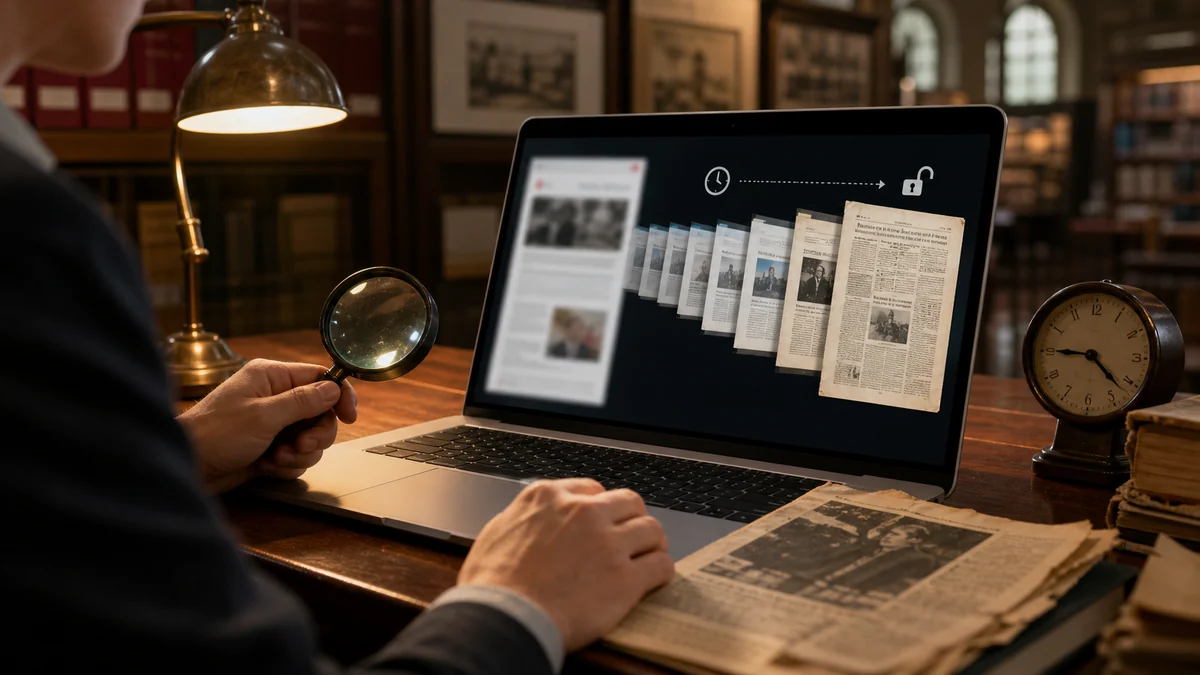
Many articles were public before they were not. Free at launch and gated later, syndicated to partners, distributed over a wire, or summarised by the publisher themselves. Finding those versions is a search problem, and search problems reward method over luck.
Key Takeaways
- Try the archive first, but with a date near publication rather than a recent capture.
- Wire-service originals are the highest-yield route for agency-sourced reporting.
- Exact-phrase search on a distinctive sentence finds syndicated copies fast.
- Always verify that an alternate version matches the original in date, byline and substance.
Preserve the Original Details First
Before searching anything, capture what you know: the exact URL, the headline as displayed, the byline, and the publication date. Thirty seconds of note-taking here prevents the most common failure mode, which is finding a plausible-looking version and having no way to check whether it is the same piece.
Headlines are the least stable of these. Publishers A/B test them, rewrite them for social, and change them after publication. If your search on the headline returns nothing, that is often why — and it is a reason to search on a body sentence instead.
Archive Lookups, Done Properly
The instinct is to open the archive and take whatever capture appears. That is usually the wrong capture.
Open the full snapshot calendar for the URL and choose a capture close to the publication date. Articles that were free at launch and gated afterwards will be complete in an early capture and truncated in a later one. A capture from last week may show you exactly the paywall you are trying to get around.
Two more archive techniques are worth knowing. First, try URL variants — with and without query strings, with and without a trailing slash, http and https, and the AMP version if the publisher used one, since AMP pages were often archived separately and were frequently unmetered. Second, use the archive's own host search to list captured URLs from that domain around the relevant date, which surfaces articles whose exact URL you had wrong.
Follow the Syndication Chain
A large share of published reporting appears in more than one place by design, through commercial arrangements that have nothing to do with circumvention.
Wire services are the biggest source. Reuters, the Associated Press, Agence France-Presse, Press Association and others distribute stories to hundreds of outlets. If the byline credits an agency, or the piece reads like straight news rather than analysis, the same text almost certainly sits on an open regional or international site.
Partner networks reprint under licence, often for free. Non-profit newsrooms such as ProPublica publish under terms explicitly encouraging republication. Regional editions of national publications sometimes run different paywall configurations for the same article.
To find them, take a distinctive sentence from the visible portion of the article — something specific enough to be unique, ideally with a number or a proper noun — and search it inside quotation marks. Syndicated copies reproduce the text exactly, so exact-phrase matching is remarkably effective.
Publisher-Side Alternatives
The same newsroom often published something adjacent and open.
- Newsletter editions. Publishers frequently summarise or reproduce their own reporting in free newsletters, and newsletter archives are usually public.
- Live blogs. Breaking coverage is commonly ungated and often contains the substance of the later gated write-up.
- Video and podcast versions. The same reporting, discussed by the same reporter, typically outside the paywall.
- Press releases. For coverage of a study, report or announcement, the underlying source document is usually open and more detailed than the article.
That last point is underrated. If the article is about research, find the paper or the institutional press release. You get the primary source rather than a summary of it.
Verifying What You Found
An alternate version is only useful if it is genuinely the same piece. Check four things before relying on it.
- Date. Syndicated copies often run a day or two later. A gap of weeks means it is probably a different story on the same subject.
- Byline. Same reporter, or a credited agency. A different named author usually means different reporting.
- Length. Syndication partners frequently cut for space. A copy that is half the length is missing something.
- Corrections. Reprints rarely receive the original's later corrections, so the open copy may preserve an error the source has since fixed.
When to Stop Looking
Set a limit. If the archive has no useful capture, an exact-phrase search on two different sentences returns nothing, and no wire or partner version appears, the article is very likely exclusive and was never public. Ten more minutes will not change that.
At that point the remaining routes are entitlement-based: a library database, an institutional login, a trial, a subscription, or a polite request to the author. Those are faster than continuing to search, and they are the routes that actually work on exclusive reporting.
Search Operators That Narrow the Field Fast
Most of the time spent hunting an older version is spent wading through results that are obviously wrong. A handful of operators cuts that down sharply, and they work across the major indexes.
- Quotation marks force exact-phrase matching. This is the single most important one — without it the engine paraphrases and you get topically similar pieces rather than the same text.
- site: restricts to one domain. Useful in reverse too: searching a distinctive sentence without the original publisher's domain surfaces the syndicated copies rather than the source.
- -site: excludes a domain, which is how you stop the paywalled original from occupying the top five results.
- intitle: requires a word in the page title, helpful when a common phrase appears in the body of thousands of unrelated pages.
- Date filters in the tools menu narrow to the publication window, which quickly separates the original from later coverage that quotes it.
A productive combination is an exact sentence from the visible portion of the article, minus the publisher's own domain, restricted to the fortnight around publication. That query is specific enough to return either the syndicated copies or nothing at all — and nothing at all is itself a useful result, because it tells you the piece was exclusive.
Choose the sentence carefully. You want something with a number, a proper noun or an unusual construction. Generic scene-setting sentences appear in hundreds of articles and will return noise no matter how precisely you quote them.
Frequently Asked Questions
Do search engine caches still work?
Largely not. Google retired its public cache links, and other engines have narrowed theirs. Archives have effectively replaced caches for this purpose.
How do I know if a story came from a wire service?
Look for an agency credit in the byline or at the end of the article, and for the characteristic neutral structure of agency copy. Searching a distinctive sentence will usually reveal a dozen identical copies if it was a wire piece.
Is reading a syndicated copy legitimate?
Yes. Syndication is a licensed commercial arrangement, and the partner site is publishing the piece with permission. You are reading an authorised copy.
Conclusion
Finding an older public article version works best as a structured search, not random clicking. Start with the canonical URL, publication date, headline variants, archives, syndication partners, and author pages. Verify that any discovered copy is complete and legitimate, then save its source details for dependable future reference and citation.
Find Access Options for Your Article
Paste a link and get nine legitimate research routes in a second.