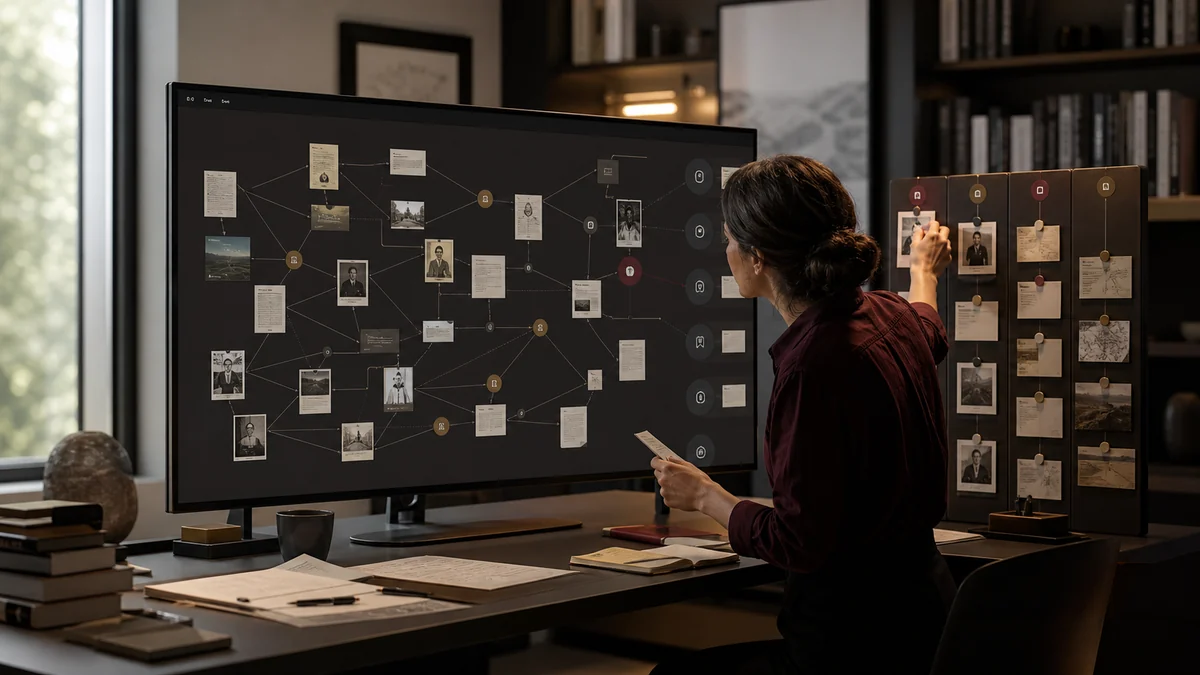
The question that ends most research sessions badly is "where did I read that?" A tracking habit that takes twenty seconds per source removes it permanently, and turns ad hoc reading into something you can audit.
Key Takeaways
- Record the access route, not just the source — it is how you reproduce the finding.
- Capture at read time; retrospective reconstruction is slow and unreliable.
- Tag by the question a source answers, not by its broad topic.
- Note version and capture dates for anything archived or preprinted.
Why the Access Route Belongs in the Record
Standard citation records the source. Research practice needs one more field: how you reached it.
Six months later, "library database" versus "archive snapshot" versus "author manuscript" tells you three different things about how easily a colleague can verify your work, whether the version you read is authoritative, and whether the finding is reproducible at all.
It also saves time directly. When you need to return to a source, knowing you reached it through a proxy login rather than an open web search means you go straight there instead of re-solving the access problem.
The Minimum Viable Record
Eight fields. Fewer and it stops being useful; more and you stop filling it in.
- Title exactly as published
- Author or byline
- Publication and date
- Canonical URL, plus DOI where one exists
- Access route — publisher, library, archive, repository, author copy
- Version — final, preprint, accepted manuscript, syndicated, snapshot
- Date accessed, and capture timestamp if archived
- Why it matters — two sentences, in your own words
The version field prevents a specific and serious error: citing a preprint's figures as though they were peer reviewed, or an archived capture's numbers as though they survived a correction.
Capture at Read Time
The single highest-leverage rule. A source recorded while you are reading takes twenty seconds. The same source reconstructed a week later takes ten minutes and is often wrong.
Make the capture step as close to zero friction as possible: a reference manager browser button, a template in your notes app bound to a keyboard shortcut, or a single text file you append to. Which tool matters far less than whether the action is fast enough that you do it.
If a source is genuinely important, trigger an archive capture at the same moment. Ten seconds then, indefinite availability afterwards.
Tag by Question, Not by Topic
Topic tags feel organised and retrieve badly. A tag like economics matches four hundred sources, which is the same as no tag at all.
Tag by the role a source plays instead: evidence-for-regional-variation, contradicts-main-thesis, methodology-critique, primary-source, needs-verification. These map to how you will actually search — you look for a source that does something, not one that is about something.
Keep a disputed or superseded tag and use it. Sources go stale, and a library that silently retains outdated material is worse than one that flags it.
Reproducibility as the Goal
The test of a tracking system is whether someone else, given your notes, could reach the same sources and reach the same conclusions.
That means recording search terms as well as results — the exact phrase that found a syndicated copy, the repository that held the manuscript, the database that carried the publication. It also means noting what you looked for and did not find, which is genuinely valuable information that almost nobody records.
A note saying "no archive capture exists for this URL between March and June" saves your future self, and anyone checking your work, from repeating a fruitless search.
Review and Prune
Set a periodic review. Check whether links still resolve, whether preprints have been published in final form, whether anything has been corrected or retracted.
Retraction in particular matters. A retracted paper cited in good faith remains in your notes indefinitely unless something prompts you to check. An annual pass through anything tagged as load-bearing catches this.
Prune aggressively. A tracking system with four hundred unreviewed entries is an archive of your browsing, not a research tool.
Recording What You Searched, Not Just What You Found
Tracking systems almost universally record hits and ignore misses, which throws away half the useful information. The searches that returned nothing are frequently more valuable than the ones that succeeded.
A note saying "searched the archive timeline for this URL, no captures between January and September" prevents you repeating the search in three months, and it documents that the absence is a property of the record rather than of your effort. In any work that will be reviewed, that distinction matters.
Record three things for a search worth keeping: the exact query string, the service you ran it against, and the date. Query wording matters because search behaviour changes and a vaguely described search cannot be reproduced. Service matters because coverage differs sharply between indexes. Date matters because a negative result is only true as of when you looked.
This is standard practice in systematic reviews for exactly this reason, and it scales down usefully to ordinary research. You do not need a formal search log — a couple of lines attached to the topic is enough to make your process reproducible.
Reviewing the Library So It Stays Trustworthy
A tracking system accumulates errors silently. Links rot, preprints become published papers with revised numbers, sources get corrected, and occasionally a paper is retracted. None of that announces itself in your notes.
Schedule one pass a year over anything load-bearing — the sources you would cite or have cited. Check that links still resolve, that preprints have not been superseded, and that nothing has been retracted or substantially corrected. It is an hour's work and it is the difference between a reference library and a collection of assumptions.
Retractions deserve specific attention. A retracted paper cited in good faith stays in your notes indefinitely unless something prompts a check, and citing one is a genuinely damaging error. Retraction Watch and the notices on publisher pages are the usual sources; for anything central to an argument it is worth the thirty seconds.
Prune at the same time. Entries you have never returned to and cannot remember capturing are noise, and a library you do not trust to be current is one you will stop consulting. Smaller and verified beats comprehensive and stale.
One habit makes the annual pass much shorter: mark entries as load-bearing at the moment you cite them. Then the review is a pass over a dozen flagged sources rather than an audit of everything you ever saved, which is the version that actually gets done.
Frequently Asked Questions
Which tool should I use?
Zotero if you cite formally; a plain-text or Markdown system if you value permanence. The habit matters more than the software.
Is this overkill for casual reading?
Yes, and that is fine. Track what you might need to defend, cite, or return to. Casual reading needs nothing.
How do I record a source I could not access?
Record it anyway, with what you tried and what failed. Knowing a route is closed is useful information.
Conclusion
Reliable source tracking connects every claim to its article, author, publication date, canonical URL, access route, and your own notes. A consistent system reduces duplicated searching and unclear attribution. Whether using a reference manager or simple spreadsheet, prioritize open formats, searchable fields, regular backups, and links others can verify independently.
Find Access Options for Your Article
Paste a link and get nine legitimate research routes in a second.