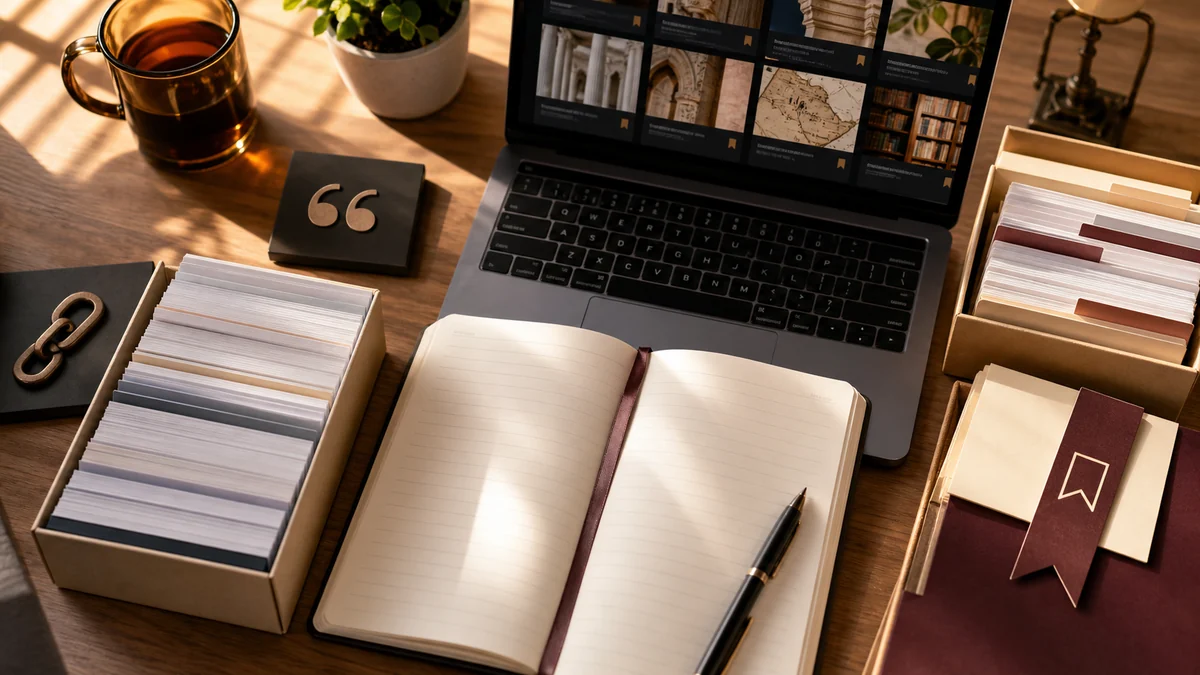
The reference library you want is not a folder of copied articles. It is a set of durable pointers plus your own thinking about them — which is both far more useful to your future self and entirely clear of copyright problems.
Key Takeaways
- Store metadata and your own notes, not full copies of other people's articles.
- Short quotes with attribution are normal scholarly practice; wholesale copies are not.
- Capture an archive link at the moment you read, because links rot fast.
- Private archival for personal study is very different from republishing to an audience.
What a Reference Actually Needs to Contain
A reference is useful when it lets you find the source again and remember why it mattered. That takes surprisingly little text — and full article copies are not part of it.
Capture these seven fields for every source:
- Headline or paper title, exactly as published
- Author or byline
- Publication and publication date
- The canonical URL, plus the DOI if there is one
- An archive link with its capture timestamp
- The date you accessed it
- Your own two-sentence summary of why it matters to your work
That last field is the one people skip and the one that pays off. A year later, a list of titles tells you nothing. A sentence saying "the only source I found with regional breakdown for 2024" tells you exactly why it is in your library.
Where the Copyright Line Sits
The distinction is not subtle, and it is worth stating clearly rather than hoping for the best.
Generally fine: saving a link; recording bibliographic metadata; writing your own summary in your own words; quoting a short passage with attribution to support a point you are making; keeping a private copy for your own study.
Generally not fine: republishing an article in full on a blog, newsletter or forum; posting entire text into a public channel; redistributing a publisher PDF; building a shared repository of copied articles; removing bylines and presenting the work as your own.
The organising principle is distribution. Reading and annotating privately sits in very different territory from making a copy available to other people. Fair use and fair dealing doctrines vary by jurisdiction and are fact-specific, but they consistently turn on how much you took, whether you transformed it, and whether you undercut the market for the original.
Quoting Well
Good quotation is short, exact and attributed. Take the sentence that carries the argument, not the three paragraphs around it.
In your notes, mark quotes unmistakably — quotation marks plus a distinct format, so that in six months you can tell instantly what is the author's wording and what is your paraphrase. The most common research failure is not plagiarism by intent; it is a note whose provenance became ambiguous.
Record a locator with every quote: page number for print or PDF, section heading for web. It makes the citation checkable and saves you re-reading the source to find it.
Fighting Link Rot
A substantial share of URLs cited in academic and legal writing stop working within a few years. Sites reorganise, publications fold, domains change hands. The reference you carefully recorded becomes a dead end precisely when someone tries to check it.
Three habits largely solve this:
- Archive at read time. Trigger a Save Page Now capture the moment you decide a source matters, and store the dated archive URL alongside the original.
- Prefer stable identifiers. A DOI resolves indefinitely. A publisher URL may not survive a redesign.
- Use a citation archiving service such as Perma.cc for anything going into formal work, which produces links designed to persist.
Storing both the live URL and the archive URL costs one extra field and preserves the reference indefinitely.
Choosing Tooling That Will Still Be Readable Later
Reference managers such as Zotero handle metadata capture, citation formatting and annotation well, and Zotero in particular exports cleanly. Plain-text and Markdown systems trade features for permanence — a folder of Markdown files will open in anything, forever.
Whatever you choose, apply two tests. Can you export everything in an open format? And would your notes still make sense to you if the application disappeared tomorrow? A library trapped inside a discontinued product is not a library.
Be especially careful with tools that offer to store full article text for you. That convenience is what turns a personal reference set into a redistribution problem the moment you share the workspace with a colleague.
Making the Library Actually Useful
A reference collection earns its keep through retrieval, not accumulation. Tag by the question a source answers rather than by its topic — "evidence-for-X" beats "economics" every time you search.
Review periodically. Sources go stale, get corrected, or get superseded. A note saying "superseded by the 2026 revision, kept for the earlier figures" is worth more than a silently outdated entry.
And write the summary while the article is still in your head. Reconstructing why something mattered, months later, from a bare title, is the tax you pay for skipping two sentences at the time.
Structuring Notes So They Survive the Project
Most reference libraries decay because they are organised around the project that created them. Six months later the project is finished, the folder names mean nothing, and the material is effectively lost even though every file is still there.
The fix is to separate two kinds of note. A source note is about the source: what it claims, how strong the evidence is, what it is useful for. It belongs with the reference and it stays valid forever. A project note is about your argument: which sources support which point, what is still missing. It belongs with the project and it dies with it.
Mixing them is what causes the decay. If your only record of a paper is "supports section 3", that is meaningless once section 3 no longer exists. If instead you wrote "only source I found with regional breakdown for 2024; sample is small and self-reported", it remains useful in every future context.
One more habit worth building: when a source changes your mind about something, write that down explicitly. Notes recording what you previously believed and why you revised it are disproportionately valuable later, both for your own thinking and for explaining your reasoning to someone else.
Keeping a Shared Library on the Right Side of the Line
Collaboration is where personal reference libraries most often drift into redistribution, usually without anyone deciding to. One person attaches PDFs for convenience, the group folder syncs, and a private study collection has quietly become a distribution channel.
The safer pattern is to share the metadata, not the files. A shared library of citations, DOIs, archive links and your own notes carries almost all of the practical value: everyone can find the source through their own entitlement, and nobody is circulating copies. Most reference managers support exactly this, with attachments kept local rather than synced to the group.
Where a group genuinely needs shared full text, the route is institutional. Ask whether your library has a licence that covers course or team use, or use a reading-list system that links through the library's authenticated access. These exist precisely because the need is common and legitimate.
Set the norm early. It is far easier to start a shared library with a stated "citations and notes only" rule than to unpick one after two years of accumulated attachments.
Frequently Asked Questions
Can I save a PDF of a paywalled article for myself?
Personal study copies sit in a much more permissive space than redistribution, but the specifics depend on your jurisdiction and the publisher's terms. What is clearly not acceptable is sharing that copy onward.
How long should a quote be?
As short as possible while still supporting your point. If you find yourself quoting several paragraphs, you probably want to summarise and quote one line instead.
Should I archive every source?
Archive anything you might cite or return to. For casual reading, a link is fine — the cost of a lost casual reference is low.
Conclusion
A durable research library stores citations, links, brief quotations, and your own analysis rather than redistributed article copies. Capture authorship, publication dates, canonical URLs, archive references, and access dates consistently. Clear separation between source material and personal notes improves attribution, retrieval, collaboration, and long-term legal confidence across every research project.
Find Access Options for Your Article
Paste a link and get nine legitimate research routes in a second.